
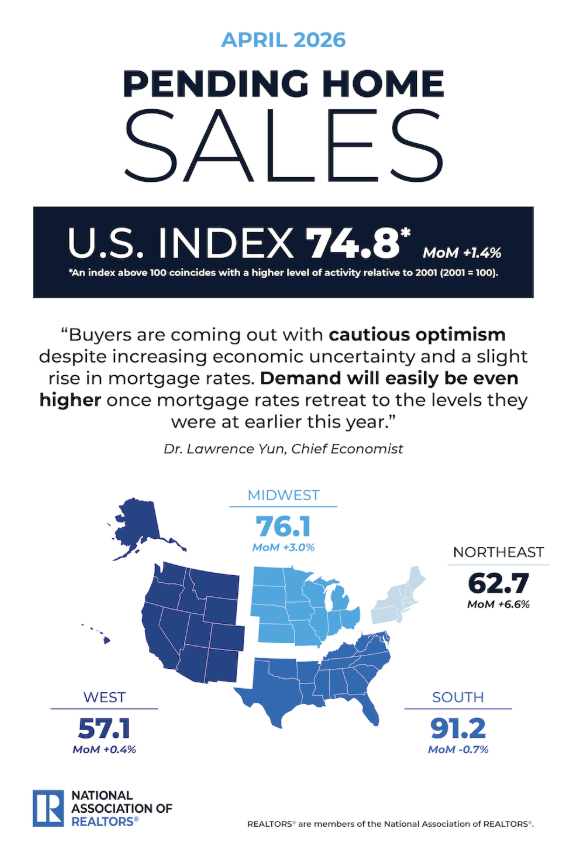
 Pending home sales rose 1.4% month over month and 3.2% year over year in April, the National Association of REALTORS® said, citing its Pending Home Sales Report.
Regionally, pending sales rose in the Northeast, Midwest and West but declined in the South. Year over year, pending home sales gained ground in the Midwest, South and West and declined in the Northeast.
“Buyers are coming out with cautious optimism despite increasing economic uncertainty and a slight rise in mortgage rates,” NAR Chief Economist Lawrence Yun said. “Demand will easily be even higher once mortgage rates retreat to the levels they were at earlier this year.
“Historically low foreclosure sales imply minimal price discounts, with a majority of markets selling at a higher price from a year ago,” Yun added. “Unless supply meaningfully increases, home price growth could outpace wage growth and further erode the homeownership rate. All efforts need to be focused on boosting housing supply.”
At the local level, several markets saw significant year-over-year gains in pending home sales. Among the top 50 metro areas, these were the top 10:
- Boston-Cambridge-Newton (+10.3%)
- Miami-Fort Lauderdale-West Palm Beach (+9.4%)
- Oklahoma City (+8.6%)
- Milwaukee-Waukesha (+7.4%)
- Virginia Beach-Chesapeake-Norfolk, Virginia (+7.2%)
- Raleigh-Cary, North Carolina (+5.7%)
- Dallas-Fort Worth-Arlington (+5.5%)
- Washington, D.C., Arlington-Alexandria, Virginia (+5.4%)
- Columbus, Ohio (+5.4%)
- Charlotte-Concord-Gastonia, North Carolina (+5.1%)
“The latest data suggest the early spring market is shaping up to be another year of modest improvement, rather than the stronger breakout many had hoped for entering the year, when lower mortgage rates and rising household incomes were boosting consumer house-buying power,” First American Senior Economist Sam Williamson said. “Since then, mortgage rates have climbed back above 6.3%, their highest level since September 2025, paring back some of those affordability gains, while broader economic uncertainty and higher energy prices weigh on consumer confidence and buyer demand.”